Japanese tree names are closely connected with nature, seasons, culture, and personal naming. Many Japanese words for trees are also used as names because they have beautiful meaning.
You will find popular Japanese tree names, their meanings, names for girls and boys, native trees, bonsai trees, cherry trees, fruit trees, sacred trees, and more.
What Is the Japanese Word for a Tree?
The most common Japanese word for tree is ki (木).
Other useful Japanese nature words include:
- Mori (森) — forest
- Hayashi (林) — grove or woodland
- Ki (木) — tree
- Kigi (木々) — trees
- Ha (葉) — leaf
- Hana (花) — flower
- Yama (山) — mountain
- Take (竹) — bamboo
- Kodama (木霊 / 木魂) — tree spirit in Japanese folklore
Popular Japanese Tree Names
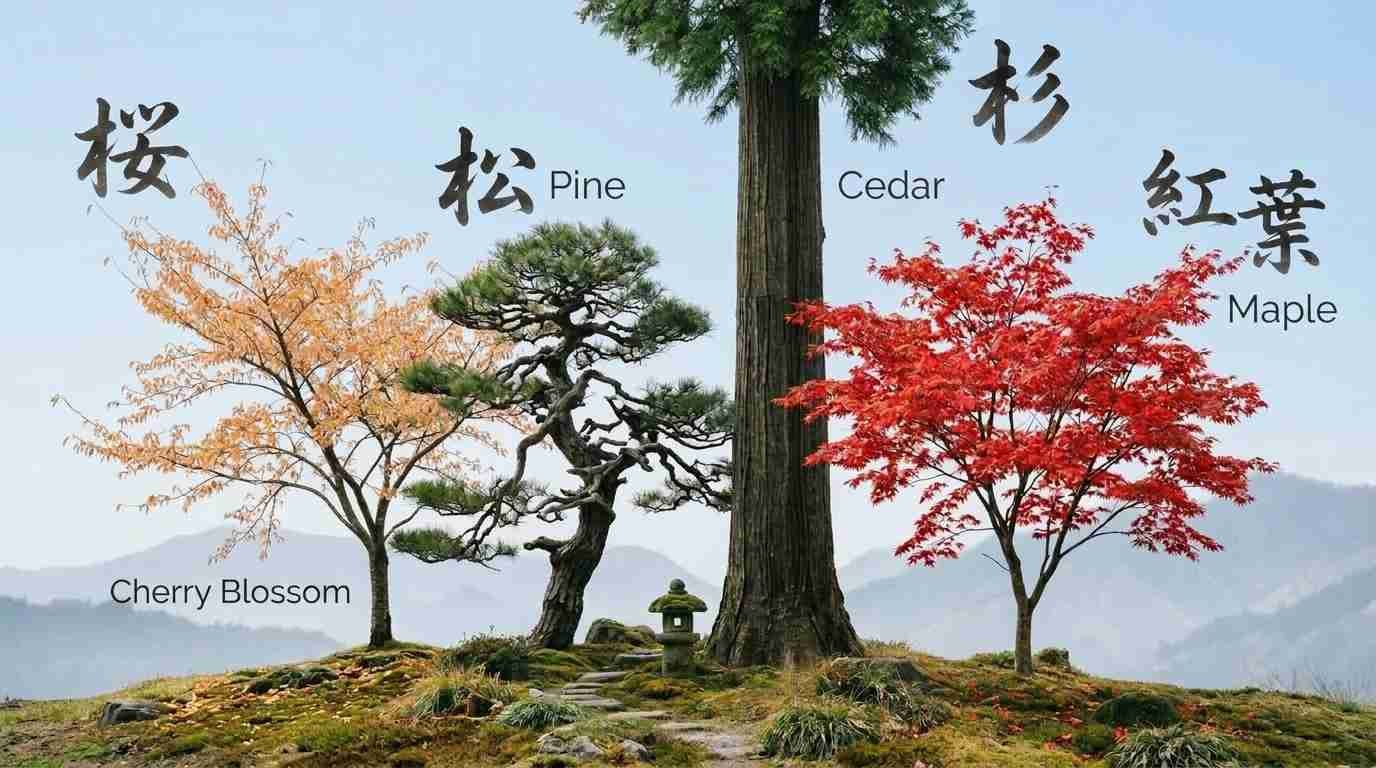
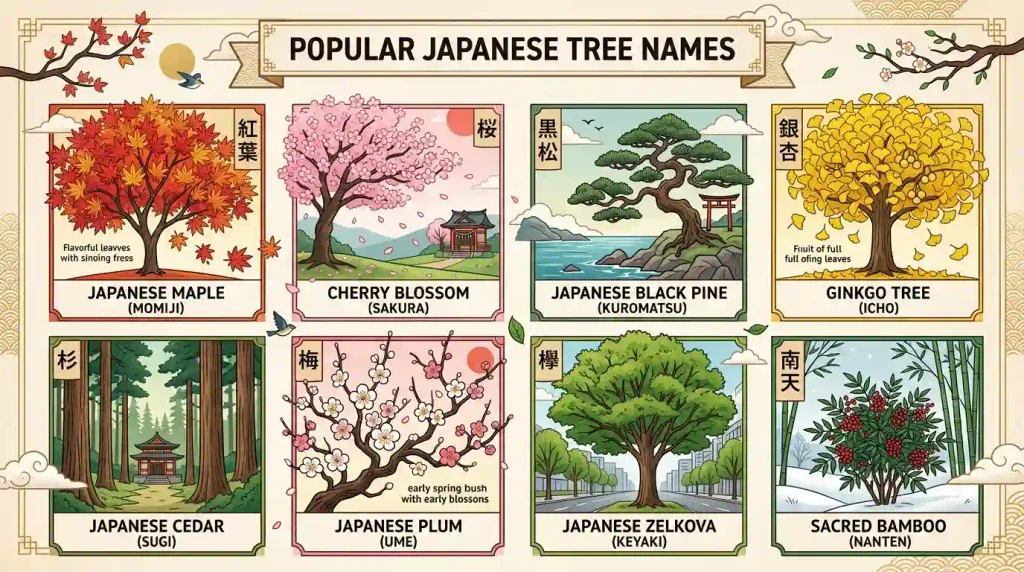
Sakura — Cherry Blossom
Sakura (桜) is one of the most famous Japanese nature names. It refers to cherry blossoms.
Cherry blossoms have a short flowering season.
Kaede — Japanese Maple
Kaede (楓) means maple.
Japanese maple trees are known for their beautiful leaves and strong autumn colors. Depending on the variety and season, the leaves may appear green, yellow, orange, or red.
Matsu — Pine
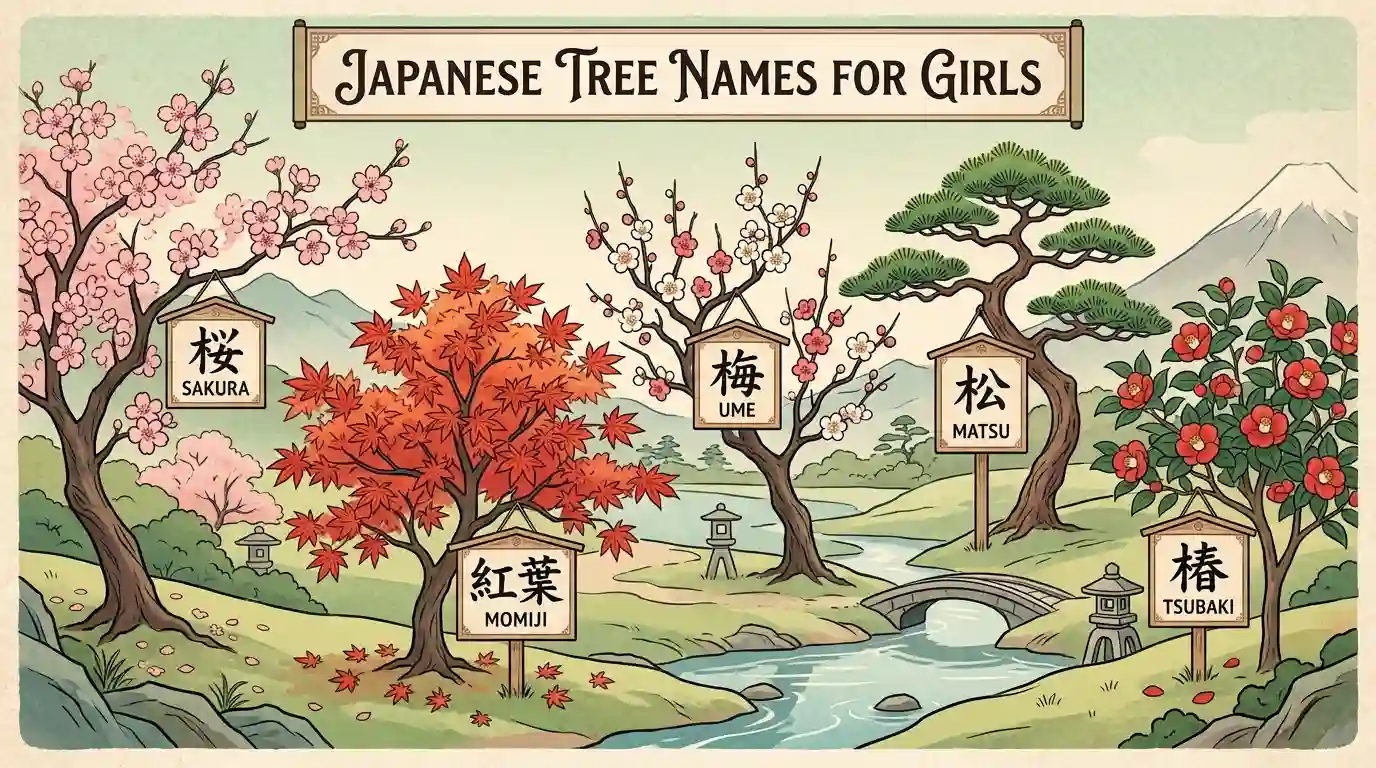
Matsu (松) means pine.
Pine trees have a long history in Japanese gardens, art, literature, and bonsai.
Common pine terms include kuromatsu, meaning Japanese black pine, and akamatsu, meaning Japanese red pine.
Sugi — Japanese Cedar
Sugi (杉) means Japanese cedar.
Its scientific name is Cryptomeria japonica. Sugi is a large evergreen tree and an important part of Japanese forests.
Some very old sugi trees are famous for their great size and age.
Hinoki — Hinoki Cypress
Hinoki (檜) refers to the Hinoki cypress.
Its scientific name is Chamaecyparis obtusa. Hinoki is valued for its beautiful wood and has traditionally been used in Japanese architecture, temples.
Kusunoki — Camphor Tree
Kusunoki (楠) means camphor tree.
Camphor trees can grow very large and live for a very long time.
Keyaki — Japanese Zelkova
Keyaki (欅) is the Japanese name for Japanese zelkova.
Its scientific name is Zelkova serrata. Keyaki is a large deciduous tree with a strong trunk and spreading branches. It is also popular as a landscape and street tree.
Kiri — Paulownia
Kiri (桐) means paulownia.
Paulownia has an important place in Japanese culture and has traditionally been used in woodworking.
Tsubaki — Camellia
Tsubaki (椿) means camellia.
The Japanese camellia, Camellia japonica, is a well-known evergreen flowering plant. Tsubaki is valued for its glossy leaves and attractive flowers and is often seen in Japanese gardens.
More Japanese Tree Names
Here are more Japanese tree and plant names you may come across:
- Kashiwa — oak
- Buna — Japanese beech
- Icho — ginkgo
- Yanagi — willow
- Kuri — chestnut
- Kaki — persimmon
- Momo — peach
- Nashi — Japanese pear
- Yuzu — yuzu citrus
- Biwa — loquat
- Fuji — Japanese wisteria
- Sakaki — sakaki
- Enoki — hackberry
- Tochi — Japanese horse chestnut
- Mokuren — magnolia
- Kobushi — Kobus magnolia
- Sarusuberi — crape myrtle
- Hanamizuki — dogwood
- Yamazakura — mountain cherry
- Shidarezakura — weeping cherry
- Yaezakura — double-flowered cherry
Japanese Tree Names and Meanings
Japanese tree names often have meanings connected with nature, seasons, appearance, history, and culture.
Sakura is connected with cherry blossoms, spring, beauty, and change.
Matsu means pine and can suggest endurance and long life.
Ume means plum in Japanese and is connected with early spring.
These meanings can make Japanese tree names a beautiful choice for people looking for nature-inspired names.
Japanese Tree Names for Girls
Some Japanese personal names are inspired by trees, flowers, and other parts of nature.
Sakura is one of the best-known Japanese nature names for girls. It refers to cherry blossoms.
Momo means peach and has a soft, nature-inspired feeling.
When choosing a Japanese name, remember that the exact meaning can depend on the kanji used.
Japanese Tree Names for Boys
Japanese boys’ names can also include tree-related kanji.
Daiki (大樹) is a well-known example. The kanji 樹 means tree, while 大 means large or great. Together, 大樹 can mean great tree or large tree.
Naoki (直樹) contains the tree-related kanji 樹.
Hiroki can have different kanji spellings, and some versions include 樹.
These names show how tree-related ideas can become part of Japanese personal names.
Japanese Girl Names Meaning Tree
Not every Japanese nature name literally means “tree.”
- Kaede — maple
- Sakura — cherry blossom
- Momo — peach
- Tsubaki — camellia
Some personal names can also use 樹, the kanji associated with a tree.
Because Japanese names can have different kanji spellings, it is important to check the exact kanji when choosing a name for its meaning.
Japanese Boy Names Meaning Tree
If you want a Japanese boy name connected with the idea of a tree, several choices are available.
Daiki (大樹) can mean great tree.
Haruki (春樹) combines spring with the tree-related kanji 樹.
Naoki (直樹) contains 樹.
The exact meaning of a personal name depends on its kanji spelling.
Japanese Family Names Related to Trees
Nature also appears in many Japanese family names.
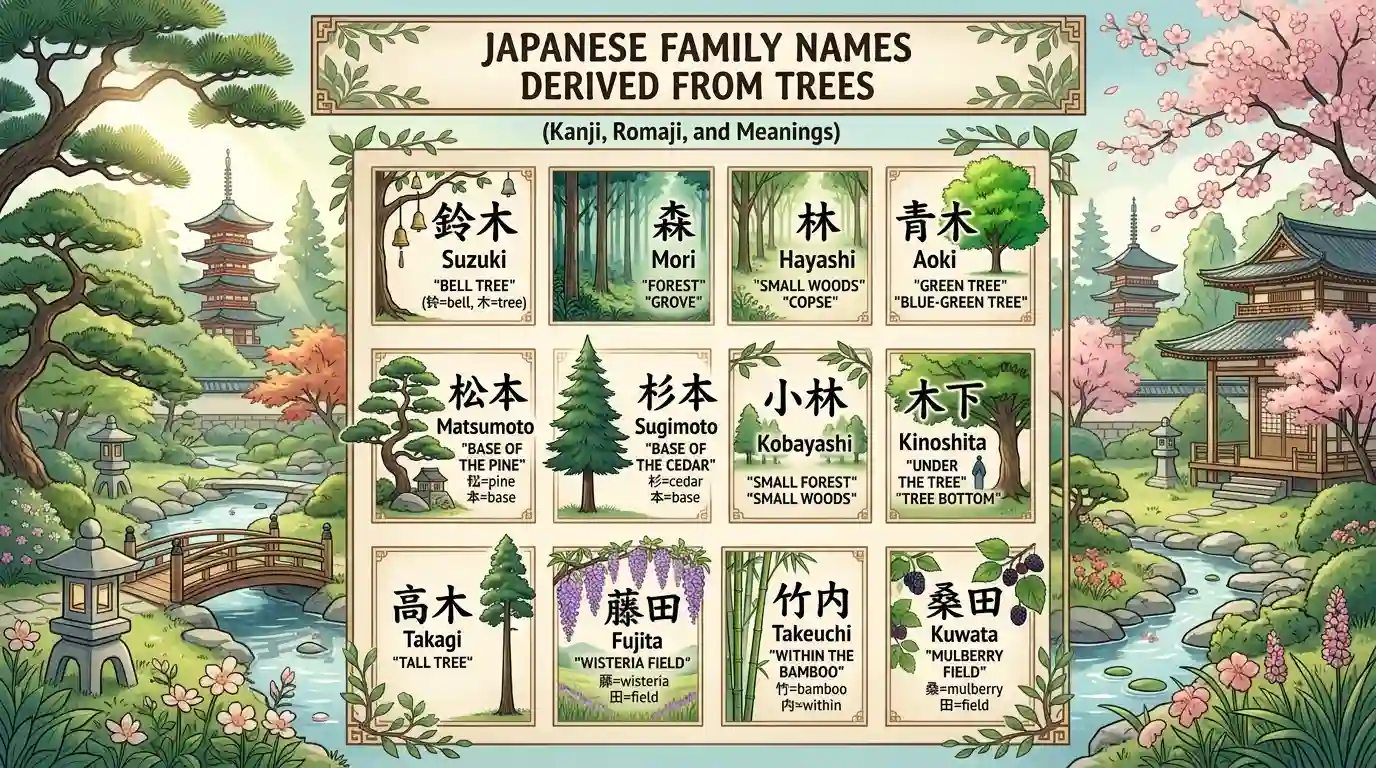
Kimura (木村) contains 木, meaning tree, and 村, meaning village.
Kinoshita (木下) combines tree and below, giving the literal idea of “under the tree.”
Matsuda (松田) combines pine and field.
Matsumoto (松本) combines pine with base or origin.
Sugiyama (杉山) combines cedar and mountain.
Mori (森) means forest.
Hayashi (林) means grove or woodland.
Japanese Evergreen Tree Names
Evergreen trees keep their leaves throughout the year.
- Matsu — pine
- Sugi — Japanese cedar
- Hinoki — Hinoki cypress
- Kusunoki — camphor tree
- Tsubaki — camellia
- Sakaki — sakaki
- Shii — Japanese chinquapin
- Shirakashi — Japanese white oak
- Tabunoki — Japanese bay tree
Japanese Maple Tree Names
One well-known species is Acer palmatum.
The Japanese word Kaede means maple. Japanese maple trees come in many shapes and sizes, and their leaves can show beautiful colors during autumn.
The changing colors of maple leaves are one reason autumn is a popular season for enjoying trees in Japan.
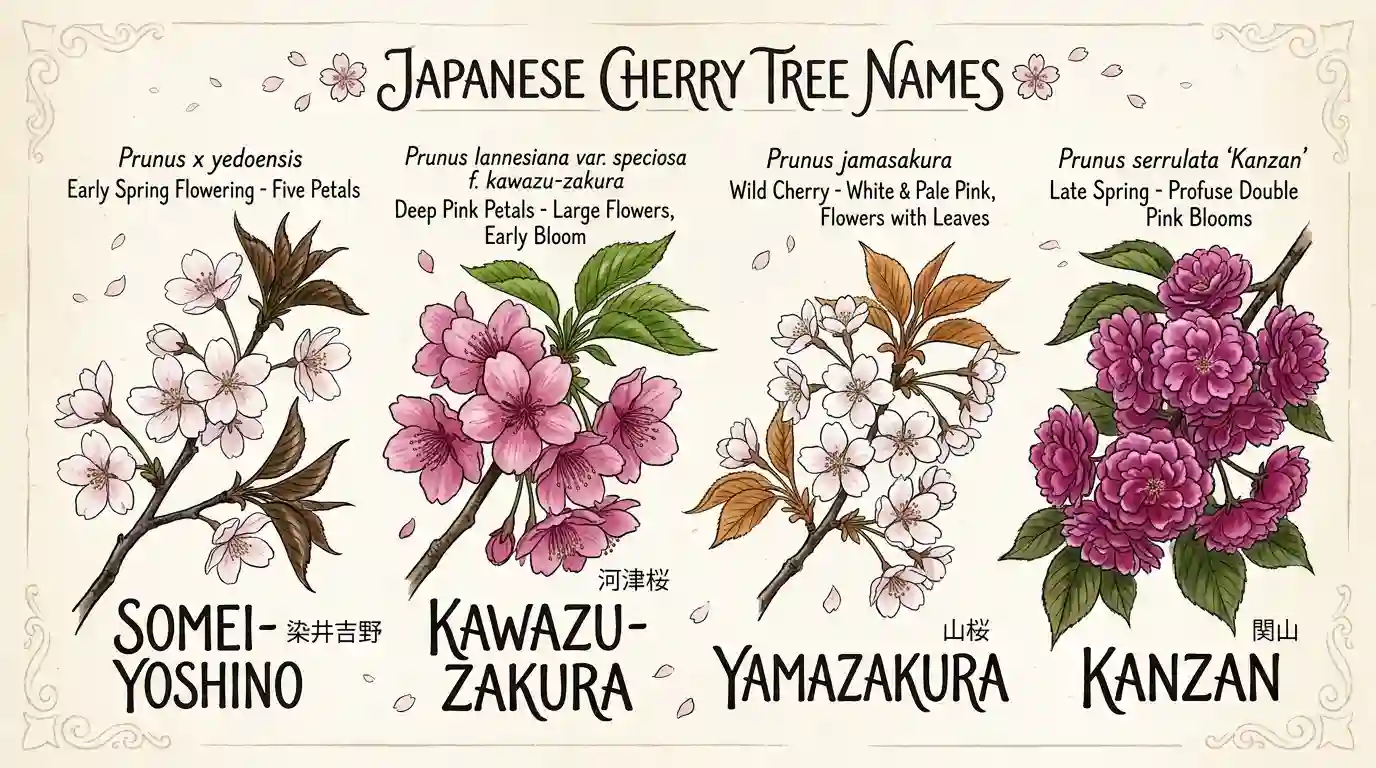
Japanese Cherry Tree Names
Cherry trees are among the most recognizable trees associated with Japan.
Some common cherry-related names include:
- Somei-yoshino
- Yamazakura
- Shidarezakura
- Yaezakura
- Oshima-zakura
Yamazakura means mountain cherry.
Shidarezakura refers to weeping cherry trees.
Yaezakura refers to double-flowered cherry blossoms.
These different cherry trees help show the variety found within Japan’s famous cherry blossom tradition.
Japanese Fruit Tree Names
Japan has many trees and woody plants that produce fruits.
Some common Japanese fruit-related names include:
- Ume — Japanese plum
- Kaki — persimmon
- Momo — peach
- Nashi — Japanese pear
- Kuri — chestnut
- Yuzu — yuzu citrus
- Biwa — loquat
- Yamamomo — Japanese bayberry
- Mikan — mandarin
- Zakuro — pomegranate
Japanese Flowering Tree Names
Popular names include:
- Sakura — cherry
- Ume — Japanese plum
- Tsubaki — camellia
- Mokuren — magnolia
- Kobushi — magnolia
- Hanamizuki — dogwood
- Sarusuberi — crape myrtle
- Fuji — Japanese wisteria
- Boke — Japanese quince
Flowering trees add seasonal color to Japanese gardens and landscapes.
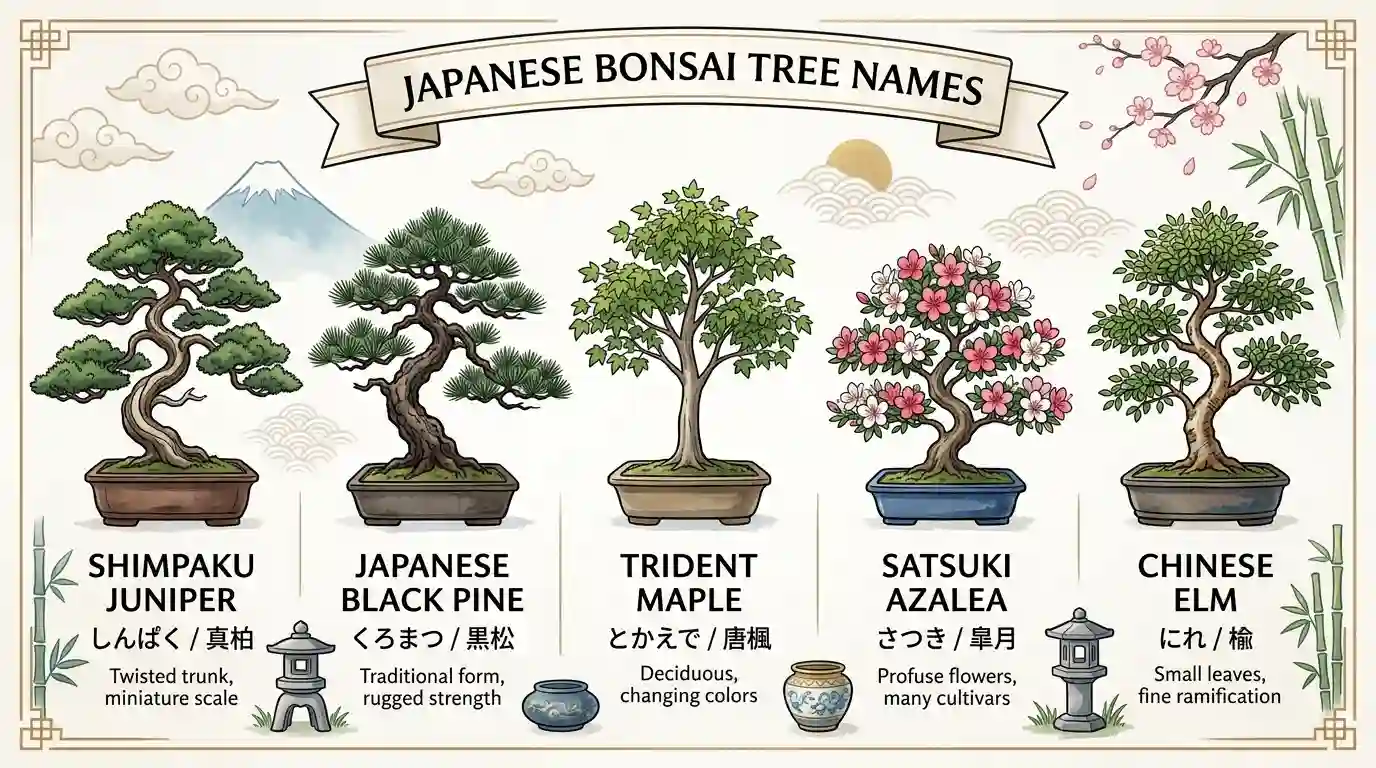
Japanese Bonsai Tree Names
People searching for Japanese bonsai trees are usually looking for tree species that are commonly trained as bonsai.
Bonsai is an art of growing and shaping trees in containers. It is not a separate tree species.
Popular bonsai choices include:
- Japanese black pine (Kuromatsu)
- Hinoki cypress (Hinoki)
- Japanese maple
- Japanese zelkova
- Satsuki azalea
Bonsai focuses on careful shaping, pruning, and long-term growth.
Small Japanese Tree Names
If you are looking for a small Japanese tree, remember that a tree’s final size depends on its species, variety, growing conditions, and pruning.
Some Japanese maple varieties can work well in smaller gardens.
Japanese holly and Japanese snowbell can also be suitable for certain landscapes.
Famous Japanese Tree Names
Japan has many famous trees that are known for their age, size, location, or cultural importance.
One of the most famous is Jōmon Sugi on Yakushima.
Jōmon Sugi is an ancient Japanese cedar and an important symbol of Yakushima’s old forests.
Yakushima is also famous for its ancient sugi trees and its rich natural environment.
Native Japanese Trees
Japan has many native tree species because the country has a wide range of climates and landscapes.
Some important Japanese trees include:
- Japanese maple
- Trident maple
- Japanese black pine
- Japanese red pine
- Japanese white pine
- Japanese cedar
- Hinoki cypress
- Japanese beech
- Japanese zelkova
- Japanese camellia
- Japanese horse chestnut
- Japanese snowbell
- Japanese paulownia
Different regions support different species.
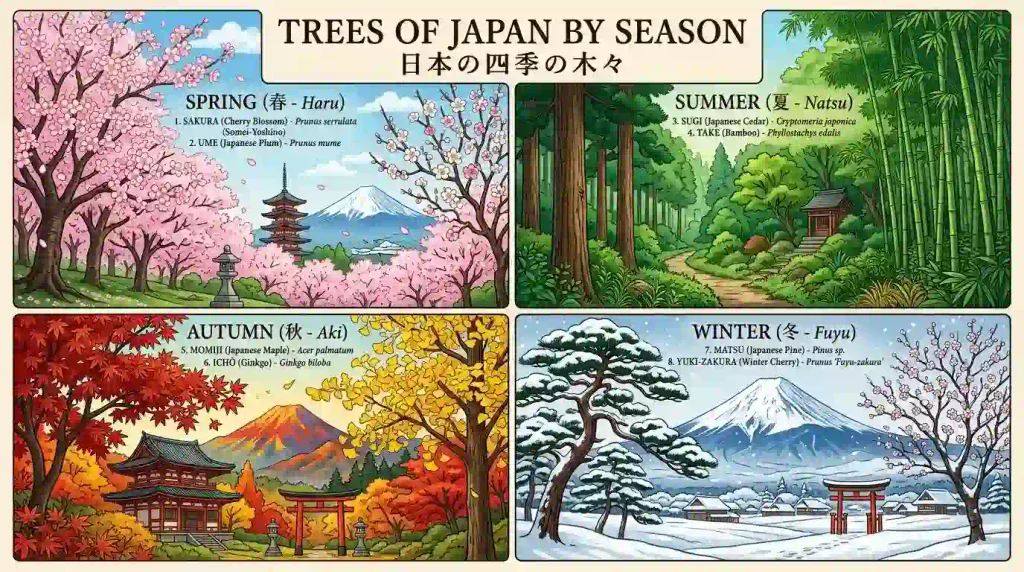
Trees of Japan by Season
Japanese trees are closely connected with the four seasons.
Spring Trees
Spring is strongly associated with flowering trees and fresh green growth.
Some spring-related trees and plants include:
- Sakura
- Ume
- Momo
- Magnolia
- Cherry trees
Cherry blossoms are one of the most recognizable signs of spring in Japan.
Summer Trees
During summer, Japanese forests and gardens become very green.
Autumn Trees
Autumn is known for colorful leaves.
Kaede and momiji are especially important during this season.
Japanese maple leaves can turn beautiful shades of red, orange, and yellow.
Winter Trees
Evergreen trees become especially noticeable during winter.
Pine, cedar, and cypress can keep their green foliage when many other trees have lost their leaves.
Japanese Trees in Gardens
Japanese gardens use trees to create balance, seasonal interest, shade, and natural beauty.
The goal is not simply to plant as many trees as possible. The shape, position, age, and seasonal appearance of each tree can all be important.
Sacred Trees of Japan
Trees have an important role in Shinto traditions.
Sakaki is especially important in Shinto and is commonly associated with shrines and sacred spaces.
There is no single universal list of exactly “five sacred trees of Japan.” Different traditions, regions, and shrines may place importance on different trees.
Japanese Tree Spirit — Kodama
If you are searching for the Japanese word for tree spirit, the term you are most likely to find is kodama (木霊 / 木魂).
In Japanese folklore, kodama are spirits associated with trees.
The traditional idea of kodama is part of Japanese folklore and beliefs surrounding certain trees and forests.
Japanese Trees and Nature in Japanese Culture
Trees appear throughout Japanese culture and daily life.
They can be found in:
- Japanese gardens
- Shrines
- Temples
- Traditional architecture
- Poetry
- Paintings
- Family names
- Personal names
- Food traditions
- Bonsai
- Seasonal celebrations
- Folklore
Cherry blossoms are strongly connected with spring, while maple leaves are closely associated with autumn.
This connection between trees and the seasons is an important part of the beauty of Japanese nature.
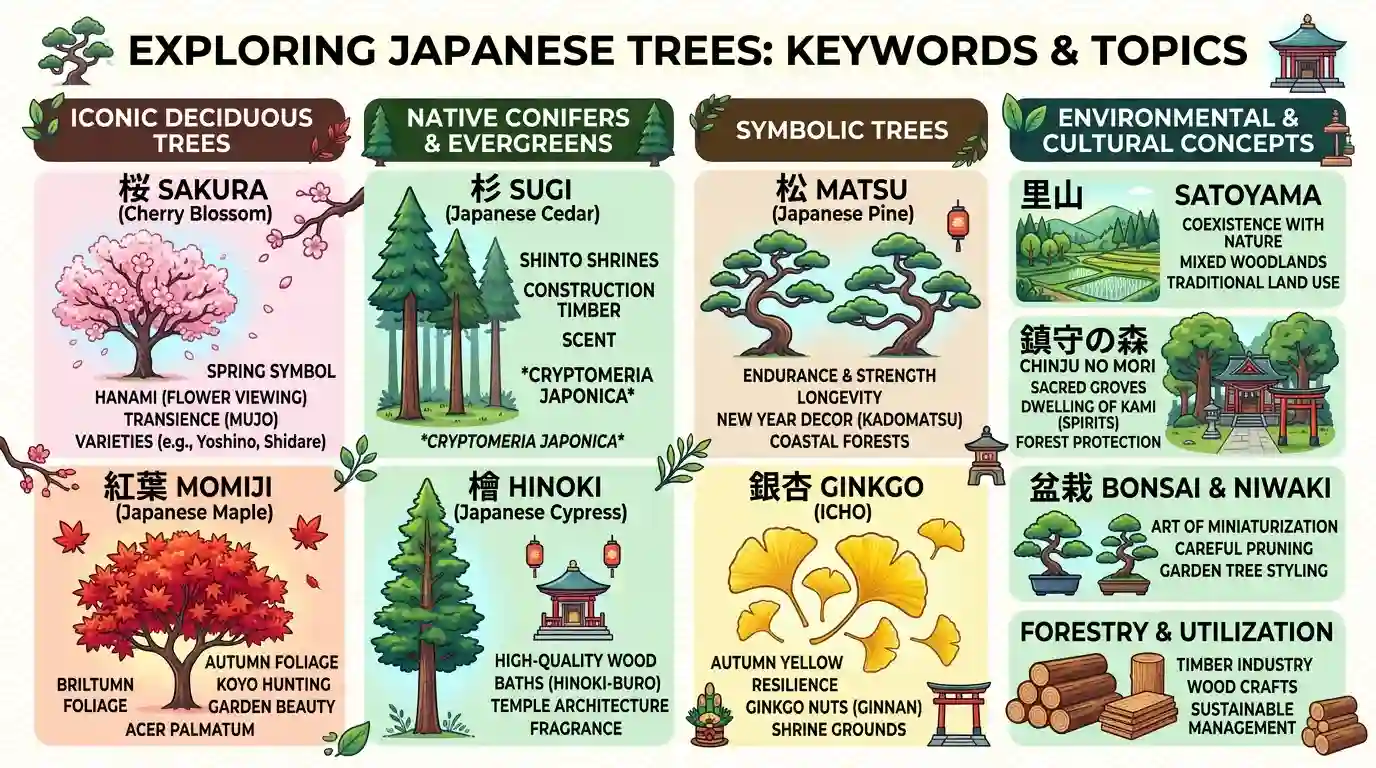
Related Japanese Tree Keywords and Topics
People searching for Japanese tree names may also be interested in:
- Japanese tree names girl
- Japanese tree names boy
- Japanese tree names and meanings
- Japanese tree names and pictures
- Famous Japanese tree names
- Japanese family tree names
- Japanese boy names meaning tree
- Japanese fruit tree names
- Japanese maple tree names
- Japanese bonsai tree names
- Japanese evergreen tree names
- Japanese cherry tree names
- Japanese cherry blossom tree names
- Japanese plum tree names
- Japanese pine tree names
- Japanese flower tree names
- Five sacred trees of Japan
- Japanese trees
- Japanese trees bonsai
- Small Japanese tree name
- Japanese word for tree spirit
How to Choose the Right Japanese Tree Name
The best Japanese tree name depends on what you want the name to represent.
If you want a name connected Ume are excellent choices.
If you prefer autumn, Kaede and Momiji are closely connected with the season.
For a name connected with strength and long life, Matsu is a good option.
If you want a name connected with a tree itself, names using the kanji 樹 may be worth considering.
FAQ
Sakura is probably the most famous Japanese tree-related name. It is associated with cherry blossoms and spring.
The most common Japanese word for tree is ki (木).
The Japanese word for maple is kaede (楓).
The Japanese word for cherry blossom is sakura (桜).
The Japanese word for pine is matsu (松).
Names containing 樹, such as Daiki (大樹), can have a tree-related meaning.
Popular tree and nature-inspired choices include Sakura, Kaede, Momo, and Tsubaki.
The exact meaning should always be checked against the kanji.
Examples include Daiki, Haruki, Naoki, and Itsuki, depending on their kanji.
Several of these names can contain 樹, meaning tree.
Popular Japanese bonsai trees include Japanese black pine, Japanese maple, Hinoki cypress, and Japanese zelkova.
Some well-known examples are matsu, sugi, hinoki, kusunoki, tsubaki, and sakaki.
Common examples include ume, kaki, momo, nashi, kuri, yuzu, biwa, and yamamomo.
Common names include sakura, Somei-yoshino, Yamazakura, Shidarezakura, and Yaezakura.
Kaede is the Japanese word for maple.
Momiji is strongly associated with colorful autumn maple foliage.
Kodama (木霊 / 木魂) is the Japanese folklore term associated with tree spirits.
There is no single universal list of five sacred trees that applies throughout Japan.
Sakaki, sugi, and hinoki all have important cultural or religious associations, but practices can vary by region and shrine.
Some tree names are also used as personal names, but they are not the same thing.
For example, Sakura refers to cherry blossoms and is also used as a personal name. Daiki can use the tree-related kanji 樹.
Examples include Kimura, Kinoshita, Takagi, Matsuda, Matsumoto, Sugiyama, Mori, Hayashi, and Kobayashi.
Conclusion
Japanese tree names show how closely nature is connected with the Japanese language and culture.
From Sakura and Ume in spring to Kaede in autumn, trees help represent the changing seasons. Matsu, Hinoki, Keyaki, Tsubaki, and many other trees also have their own history.
Whether you are looking for Japanese tree names for girls, boys, a nature-inspired personal name, a bonsai tree, or simply learning about Japanese trees, these names offer many beautiful choices.

Aiko Tanaka is a Japanese names writer and cultural editor at JapaneseNameHub.com. She writes about Japanese names, their meanings, kanji, pronunciation, and the traditions behind them.
Aiko enjoys exploring the stories and ideas connected to Japanese names and presenting them in a simple, clear way for readers around the world. Her work focuses on making Japanese names easier to understand while keeping cultural context in mind.