
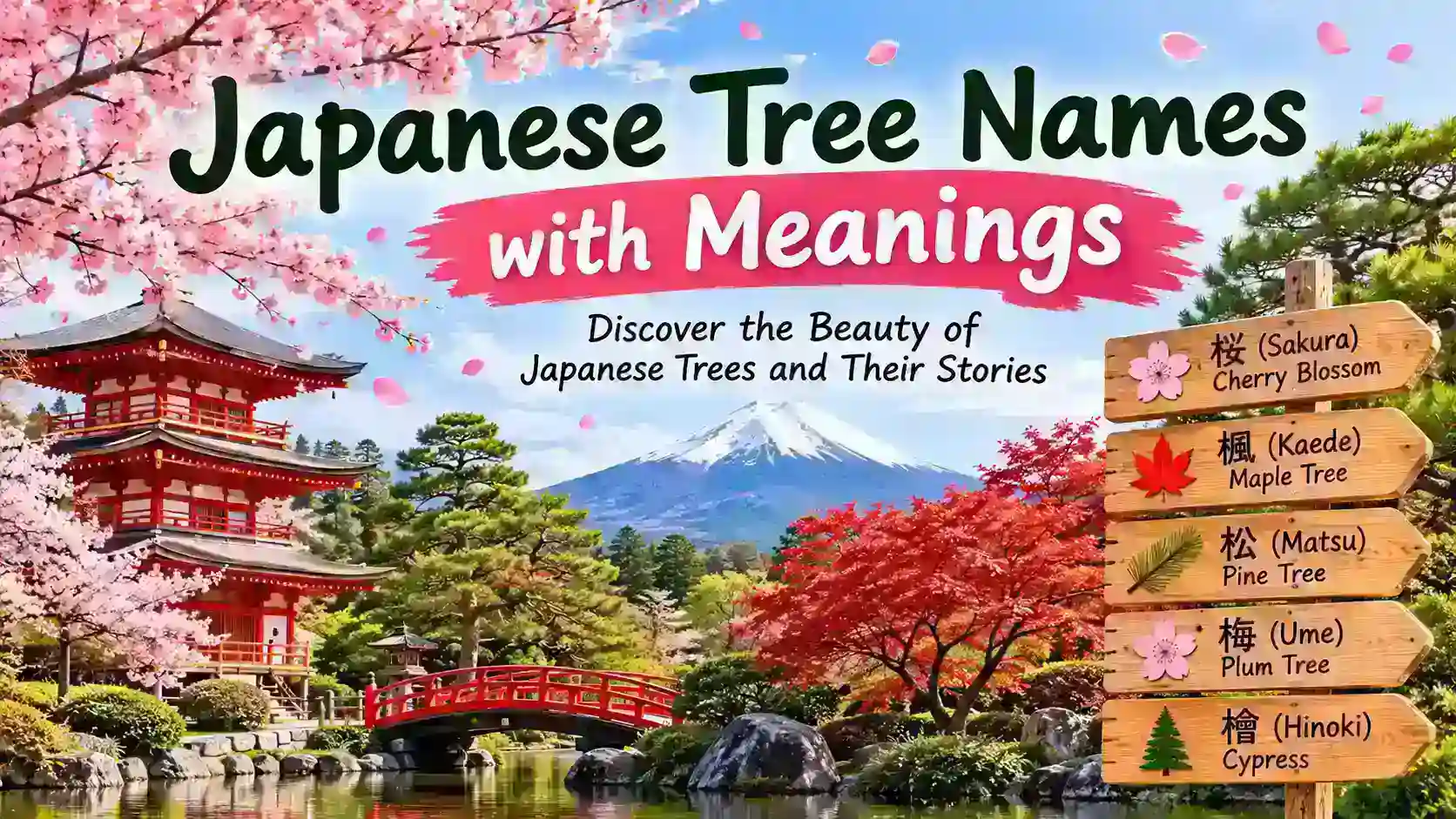
Japanese tree names have beautiful meanings. Some names come from flowers, leaves, forests, and nature. Others come from old Japanese words and Kanji characters.
Japan has many special trees. These include cherry trees, maple trees, pine trees, Japanese cedar, cypress, and plum trees. Many of these trees are also linked to Japanese culture, gardens.
In this guide, you will learn Japanese tree names with meanings, their Kanji, Hiragana, and English names. You will also find Japanese boy and girl names, small trees, bonsai trees, fruit trees, sacred trees, and nature-inspired names.
What Is the Japanese Word for a Tree?

The Japanese word for tree is Ki (木).
Here is how to write and say it:
- Kanji: 木
- Hiragana: き
- Romaji: Ki
- English meaning: Tree or wood
The word No-ki (の木) can mean a type of tree when added to another word.
For example, Sakura-no-ki means a cherry tree.
Japanese Tree Names with Meanings
Japan has many native trees. Each tree has its own shape, flowers, leaves, and place in nature.
Here are some popular Japanese tree names and their meanings.
| Japanese name | Japanese writing | English name |
| Sakura | 桜 | Cherry tree |
| Kaede | 楓 | Maple tree |
| Matsu | 松 | Pine tree |
| Ume | 梅 | Japanese plum |
| Hinoki | 檜 | Japanese cypress |
| Sugi | 杉 | Japanese cedar |
| Kiri | 桐 | Paulownia tree |
| Kaki | 柿 | Persimmon tree |
| Momo | 桃 | Peach tree |
| Kuri | 栗 | Japanese chestnut |
| Yanagi | 柳 | Willow tree |
| Keyaki | 欅 | Japanese zelkova |
| Kashiwa | 柏 | Japanese oak |
| Kuwa | 桑 | Mulberry tree |
| Ichō | 銀杏 | Ginkgo tree |
| Shirakaba | 白樺 | White birch |
| Tochi | 栃 | Japanese horse chestnut |
| Tachibana | 橘 | Japanese citrus tree |
| Tsubaki | 椿 | Japanese camellia |
| Enoki | 榎 | Japanese hackberry |
Some names, such as Matsu and Yanagi, can refer to a group of related trees rather than one exact species.
Japanese Trees and Their Scientific Names
Scientific names help people identify trees around the world. They are useful because one tree can have different common names in different countries.
Here are some Japanese trees and their scientific names.
| Japanese name | English name | Scientific name |
| Sakura | Japanese flowering cherry | Prunus serrulata |
| Ume | Japanese plum | Prunus mume |
| Kaede | Maple | Acer species |
| Hinoki | Japanese cypress | Chamaecyparis obtusa |
| Sugi | Japanese cedar | Cryptomeria japonica |
| Kiri | Paulownia | Paulownia tomentosa |
| Kaki | Japanese persimmon | Diospyros kaki |
| Momo | Peach | Prunus persica |
| Kuri | Japanese chestnut | Castanea crenata |
| Keyaki | Japanese zelkova | Zelkova serrata |
| Kuwa | Mulberry | Morus species |
| Ichō | Ginkgo | Ginkgo biloba |
| Yanagi | Willow | Salix species |
| Tsubaki | Japanese camellia | Camellia japonica |
These names help readers learn both Japanese words and plant science.
Japanese Tree Names for Boys
Some Japanese names use Kanji linked to trees, plants, and nature.
Here are some examples of Japanese boy names with tree-related meanings.
| Name | Example Kanji | Possible meaning |
| Itsuki | 樹 | Tree |
| Hiroki | 宏樹 | Great or wide tree |
| Tomoki | 智樹 | Wisdom and tree |
| Kazuki | 和樹 | Harmony and tree |
| Kōki | 光樹 | Light and tree |
| Toshiki | 利樹 | Benefit and tree |
| Ritsuki | 立樹 | Standing tree |
| Yūki | 優樹 | Kindness and tree |
The meaning of a Japanese name depends on its Kanji. The same name may have different spellings and meanings.
Japanese Tree Names for Girls

Japanese natural words can also inspire beautiful girl names.
| Name | Example writing | Nature meaning |
| Sakura | 桜 | Cherry blossom |
| Kaede | 楓 | Maple |
| Ume | 梅 | Plum blossom |
| Mizuki | 瑞樹 | A name using tree Kanji |
| Juri | 樹里 | A name using tree Kanji |
| Anju | 杏樹 | Apricot and tree |
| Saki | 沙樹 | A name using tree Kanji |
| Aoi | 葵 | Hollyhock or mallow |
These names are not all limited to girls.
Japanese Tree Names for Babies
Japanese tree names can be a lovely choice for parents who like nature-inspired names.
A tree can represent life, strength, growth, peace, and beauty. These ideas make tree-related names meaningful.
Some popular choices include:
- Kaede: Maple tree.
- Sakura: Cherry blossom.
- Mizuki: A name that can include tree Kanji.
- Hiroki: A name that can combine the idea of greatness with a tree.
- Ume: Japanese plum blossom.
- Anju: A name that can combine apricot and tree Kanji.
Always check the exact Kanji before choosing a Japanese baby name. A name’s sound alone does not tell you its full meaning.
Unique Japanese Nature Names
Japanese natural words can inspire names with lovely meanings. Some are related to trees, while others are linked to leaves, flower.
| Name | Japanese writing | Meaning |
| Momiji | 紅葉 | Autumn leaves |
| Wakaba | 若葉 | Young leaves |
| Konoha | 木の葉 | Tree leaves |
| Sakaki | 榊 | Sacred Shinto tree |
| Nagi | 凪 | Calm or stillness |
| Iroha | いろは | A traditional Japanese syllabary order |
| Aoi | 葵 | Hollyhock or mallow |
| Hagi | 萩 | Bush clover |
| Katsura | 桂 | Katsura tree |
| Mayumi | 檀 | Japanese spindle tree |
Some of these words are also personal names. Their meanings may change with the Kanji used.
Japanese Tree Names in Kanji and Hiragana
Japanese has three main writing systems: Kanji, Hiragana, and Katakana.
Kanji characters often carry meaning. Hiragana shows how a word sounds.
Here are a few examples:
| English | Kanji | Hiragana | Romaji |
| Tree | 木 | き | Ki |
| Cherry tree | 桜 | さくら | Sakura |
| Maple | 楓 | かえで | Kaede |
| Pine | 松 | まつ | Matsu |
| Plum | 梅 | うめ | Ume |
| Willow | 柳 | やなぎ | Yanagi |
| Cedar | 杉 | すぎ | Sugi |
| Cypress | 檜 | ひのき | Hinoki |
Some plant names have more than one written form. The writing may also change depending on the type of tree.
Small Japanese Tree Names
Small Japanese trees are popular in gardens, parks, and bonsai collections. Some grow well in pots, while others need open space.
Here are a few examples:
Japanese Maple (Kaede)
Their leaves can turn red, orange, or yellow in autumn.
Japanese Black Pine (Kuromatsu)
Japanese black pine is an evergreen tree. It is also popular in bonsai art.
Japanese Plum (Ume)
Ume trees have lovely flowers. They bloom near the end of winter or at the start of spring.
Japanese Camellia (Tsubaki)
Tsubaki is an evergreen shrub or small tree. It has bright flowers and dark green leaves.
Japanese Flowering Cherry (Sakura)
Some cherry trees can grow in small gardens. Their pink or white flowers are a well-known sign of spring in Japan.
The best tree for a small garden depends on its final size, climate, and growing needs.
Japanese Bonsai Trees and Their Names

Bonsai is the art of growing and shaping small trees in containers. It is a popular part of Japanese garden culture.
Bonsai trees are not a special small tree species. They are normal trees that people carefully train to stay small.
Some popular trees used for bonsai include:
- Matsu: Pine trees are classic bonsai choices.
- Juniper: Juniper trees are common in bonsai art.
Bonsai needs regular care. It may need careful watering, pruning, sunlight, and root care.
Japanese Fruit Trees and Their Names
Japan has many fruit trees. Here are some common Japanese fruit tree names.
| Japanese name | English name |
| Kaki (柿) | Persimmon |
| Momo (桃) | Peach |
| Ume (梅) | Japanese plum |
| Kuri (栗) | Chestnut |
| Nashi (梨) | Japanese pear |
| Ringo (林檎) | Apple |
| Kuwa (桑) | Mulberry |
| Biwa (枇杷) | Loquat |
| Ichijiku (無花果) | Fig |
| Zakuro (柘榴) | Pomegranate |
| Anzu (杏) | Apricot |
| Yuzu (柚子) | Japanese citrus fruit |
Their growing needs depend on the climate and soil.
Japanese Flowering Trees and Their Names

Flowering trees make gardens bright and colorful. Japan is famous for its cherry blossoms, but many other trees also produce beautiful flowers.
Sakura (桜)
Sakura means cherry blossom. These flowers are a famous part of Japanese spring.
Ume (梅)
Ume is the Japanese plum tree. Its flowers often appear before cherry blossoms.
Momo (桃)
Momo means peach. Peach trees have soft pink flowers.
Tsubaki (椿)
Tsubaki is a Japanese camellia. It has large flowers and shiny green leaves.
Fuji (藤)
Fuji means wisteria. It is a climbing plant with long groups of flowers, not a tree.
These plants show the beauty of Japanese gardens in different seasons.
Japanese Trees with Beautiful Autumn Colors
Autumn is a special season in Japan. Many trees change color as the weather becomes cooler.
Some popular trees with autumn colors include:
- Kaede: Japanese maple with red, orange, and yellow leaves.
- Ichō: Ginkgo tree with bright yellow leaves.
- Sakura: Some cherry trees have colorful autumn leaves.
- Katsura: Known for its golden autumn color and sweet smell.
- Nanakamado: Japanese rowan, known for colorful leaves and berries.
People enjoy autumn colors in parks, gardens, and mountain areas across Japan.
Japanese Forest Trees and Their Names
Japan has forests with many kinds of trees. Some are evergreen, while others lose their leaves in autumn.
Here are some common Japanese forest trees:
- Sugi (杉): Japanese cedar.
- Hinoki (檜): Japanese cypress.
- Matsu (松): Pine.
- Buna (ブナ): Japanese beech.
- Keyaki (欅): Japanese zelkova.
- Shirakaba (白樺): Japanese white birch.
- Kashiwa (柏): Japanese oak.
- Tsuga (栂): Japanese hemlock.
These trees are important parts of natural forests and local landscapes.
Five Sacred Trees of Japan

Trees have a special place in Japanese culture and Shinto traditions.
There is no single official list of exactly five sacred trees for all of Japan. However, these five examples help explain the role of trees in Japanese culture.
Sakaki (榊)
Sakaki is one of the best-known sacred trees in Shinto.
These trees do not have the same sacred role everywhere. Their meaning can change from one shrine or region to another.
Japanese Trees in Culture and History
Trees are more than plants in Japanese culture. They can represent life, peace, strength, beauty, and change.
Sakaki has a special role in Shinto ceremonies. This shows that people should treat them with care.
Japanese gardens also use trees to create calm and beautiful spaces. Pine, maple, cypress, and other plants can help make a garden feel peaceful.
Japanese Plant Names Beyond Trees
Japan has many plants that are not trees but are still important in gardens and nature.
| Japanese name | Japanese writing | English name |
| Fuji | 藤 | Wisteria |
| Hagi | 萩 | Bush clover |
| Asebi | 馬酔木 | Japanese andromeda |
| Tsutsuji | 躑躅 | Azalea |
| Mokuren | 木蓮 | Magnolia |
| Erika | エリカ | Heath |
| Kakitsubata | 杜若 | Japanese water iris |
| Bashō | 芭蕉 | Japanese banana plant |
| Ichigo | 苺 | Strawberry |
| Take | 竹 | Bamboo |
Bamboo is often seen in Japanese gardens, but it is a grass, not a tree. Wisteria is also a climbing plant.
Japanese Tree Names in Urdu
Here are some Japanese tree names with their English and Urdu meanings. Urdu names can change from one area to another.
| Japanese name | English name | Urdu name |
| Sakura | Cherry tree | جاپانی چیری |
| Kaede | Maple tree | پیپل کا درخت |
| Matsu | Pine tree | چیڑ کا درخت |
| Ume | Japanese plum | جاپانی آلو بخارا |
| Hinoki | Japanese cypress | جاپانی صنوبر |
| Sugi | Japanese cedar | جاپانی دیودار |
| Kaki | Persimmon | جاپانی املوک |
| Momo | Peach tree | آڑو کا درخت |
| Kuri | Chestnut tree | شاہ بلوط کا درخت |
| Yanagi | Willow tree | بید کا درخت |
| Kuwa | Mulberry tree | شہتوت کا درخت |
| Ringo | Apple tree | سیب کا درخت |
Some Urdu names are general names for a type of tree. They may not refer to the exact Japanese species.
Tree Names in Pakistan
Pakistan has many trees that grow in different climates. Some grow in warm areas, while others grow in cold mountain regions.
Here are some common tree names in Pakistan.
| English name | Urdu name |
| Neem | نیم |
| Mango | آم |
| Banyan | برگد |
| Peepal | پیپل |
| Shisham | شیشم |
| Kikar | کیکر |
| Mulberry | شہتوت |
| Eucalyptus | سفیدہ |
| Pine | چیڑ |
| Deodar | دیودار |
| Olive | زیتون |
| Date Palm | کھجور |
These trees are found in different parts of Pakistan. Their growth depends on local weather, soil, and water.
Jackfruit Tree Name in Pakistan
Jackfruit is a tropical fruit that grows on a large tree.
In Urdu, jackfruit is commonly called Kathal (کٹہل). The tree is known as the Kathal tree or jackfruit tree.
In Japanese、 jackfruit is called Jakkufurūtsu (ジャックフルーツ). The phrase for jackfruit tree is Jakkufurūtsu no ki (ジャックフルーツの木).
Jackfruit grows in warm and humid areas. It is more common in tropical regions than in the cooler parts of Pakistan.
Tree Names in Pashto
Some common tree names may have different local forms in Pashto. The words can also change between regions.
Here are a few familiar names:
| English name | Urdu name | Pashto name |
| Pine | چیڑ | Nakhتر |
| Mulberry | شہتوت | توت |
| Olive | زیتون | زیتون |
| Willow | بید | بید |
| Walnut | اخروٹ | غوز |
Local Pashto names may differ by dialect, so it is helpful to check the name used in your area.
How to Choose a Japanese Tree Name

Choosing a Japanese tree name can be fun. You can select a name based on its sound, meaning, or nature connection.
Here are some simple tips:
- Choose a tree name with a meaning you like.
- Check its Kanji and Hiragana spelling.
- Learn how to say the name correctly.
- Check whether it is a plant name, personal name, or both.
- Look at the meaning of each Kanji character.
- Ask a Japanese speaker to check the name before using it for a baby.
A name should sound good and have a meaning that matters to you.
FAQs
The Japanese word for tree is Ki (木). It is written as き in Hiragana.
Some popular Japanese tree names are Sakura, Kaede, Matsu, Ume, Hinoki, Sugi, Kaki, and Yanagi.
Itsuki, Hiroki, Tomoki, Kazuki, and Kōki are examples of Japanese names that can use tree-related Kanji.
Sakura, Kaede, Ume, Mizuki, Juri, and Anju are examples of names connected with nature or tree Kanji. Their gender use and meaning can depend on the writing.
Kodama (木霊 or 木魂) is a Japanese word linked to tree spirits and echoes in folklore.
Shinboku (神木) means a sacred or divine tree. Sakaki (榊) is a well-known tree used in Shinto rituals.
The Japanese word for maple is Kaede (楓).
The Japanese word for cherry tree is Sakura (桜).
Sakaki, Sugi, Matsu, Hinoki, and Sakura are useful examples of trees with cultural or religious importance. Japan does not have one official list of exactly five sacred trees.
Jackfruit is called Jakkufurūtsu (ジャックフルーツ) in Japanese. Jackfruit tree is Jakkufurūtsu no ki.
Common Urdu tree names include Neem (نیم), Mango (آم), Banyan (برگد), Peepal (پیپل), Shisham (شیشم), and Mulberry (شہتوت).
Yes. Some Japanese natural words and Kanji combinations are used as personal names. However, the meaning depends on the exact Kanji chosen.
Final Thoughts
Japanese tree names with meanings offer a beautiful way to learn about Japanese language, nature, and culture. Names such as Sakura, Kaede, Matsu, Ume, and Hinoki are linked to trees that play an important role in Japan.
You can also explore Japanese boy names, girl names, bonsai trees, fruit trees, flowering plants, and sacred trees. Words such as Ki, Kodama, and Shinboku show how Japanese language and culture connect with nature.
Whether you are choosing a baby name or learning about Japanese trees, these names can help you discover the beauty of Japan’s natural world.

Aiko Tanaka is a Japanese names writer and cultural editor at JapaneseNameHub.com. She writes about Japanese names, their meanings, kanji, pronunciation, and the traditions behind them.
Aiko enjoys exploring the stories and ideas connected to Japanese names and presenting them in a simple, clear way for readers around the world. Her work focuses on making Japanese names easier to understand while keeping cultural context in mind.


