
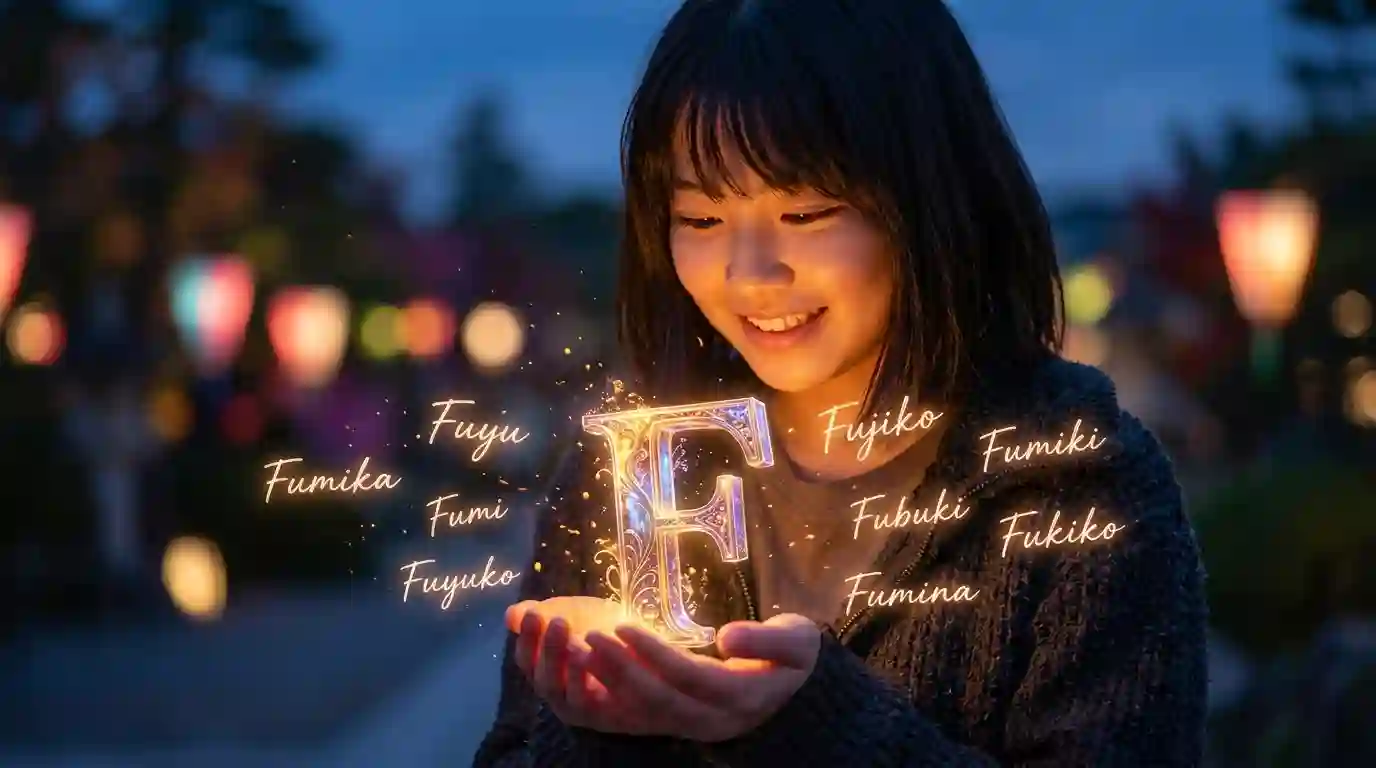
Quick answer: Popular Japanese names that start with F include Fumiko, Fuyumi, Fubuki, Futaba, and Fuuka for girls. Popular boy names include Fumio, Fujio, Fuyuki, Fumiya, and Fuuma. Common last names are Fujita, Fujiwara, Fukuda, and Fukushima. Almost every Japanese name that starts with F begins with “Fu.” That is because Japanese has only one real F sound: ふ (fu).
Japanese names often have a deep meaning. The meaning comes from kanji. Kanji are the Chinese characters used in Japanese writing. This guide gives you girl names, boy names, and last names. You will learn how the names sound, how they are written, and how to pick one with the meaning you like.
Why Almost All Japanese Names That Start With F Begin With “Fu”

Japanese writing has no letter F. It is written in sounds, called syllables. The only sound close to an English F is ふ. In English letters, it is written “fu.” It is a soft sound. Blow air gently through your lips. Do not touch your teeth to your lip like you do for the English F.
So Japanese names that start with F almost always start with Fu. Here are the main groups:
- Fumi: writing, books, and history
- Fuyu: winter
- Fuji: wisteria (a purple flower), or Mount Fuji
- Fuku: luck and good fortune
- Fuu or Fū: wind or the maple tree
- Fusa: a tassel or a bunch
- Futa: a pair, like two leaves
When you search for Japanese names that start with F, you are really searching for names that start with the sound “fu.” Names that start with “fa” or “fi” are not traditional. You will see why below.
How Japanese Names Work
A few simple facts will help you with every name in this guide.
- Family name first. In Japan, the family name comes first. In Fujiwara Takumi, Fujiwara is the family name.
- Kanji gives the meaning. One sound can be written with different kanji. Each kanji has its own meaning.
- Hiragana and katakana give only sound. These two scripts do not carry a hidden meaning.
- Romaji is an English letter. It is a way to write Japanese sounds with the letters we know.
- Endings hint at gender. Many names end with a small piece that points to a girl or a boy.
- Nicknames are common. Friends add -chan or -kun. You can say Fumi-chan or Fuyuki-kun.
Do Japanese People Have Middle Names?
No. Most Japanese people have a family name and a first name. That is all. A child with one parent from another country may have a middle name. For example, Emi Grace Fujita. That is a choice, not a Japanese rule.
Japanese Name Suffixes: -san, -kun, -chan, and -sama
Japanese people add a small word after a name. It shows how close or how polite the speaker is. You can say Fujita-san or Fumi-chan.
| Suffix | Used for | Feel |
| -san | Almost anyone | Polite, like “Mr.” or “Ms.” |
| -kun | Boys, young men, or juniors | Friendly |
| -chan | Small children and close friends | Cute and kind |
| -sama | Customers and very important people | Very respectful |
| -senpai | A student or worker with more experience | Respectful |
| -sensei | Teachers and doctors | Respectful |
If you are not sure, use -san. Never add a suffix to your own name.
Helper Marks for Reading Names
Some names are hard to read, so Japanese writing has a few helpers.
- Furigana: Tiny hiragana letters written above or beside a kanji. They show how to say it.
- Okurigana: Hiragana letters that come after a kanji in a word. They help finish the word.
- Long vowel mark: In katakana, a long line (ー) makes a vowel last longer.
- Morae: The beats of a name. Japanese people count names by beats. Fu-mi-ko has three beats. Fu-yu-ki also has three beats. Most Japanese names have two to four beats. This gives the name its rhythm.
Japanese Names That Start With F Girl

Here are Japanese girl names that start with F. These are also called female Japanese names that start with F.
| Name | Kanji | Meaning |
| Fumiko | 文子 | Child of writing or books |
| Fumie | 文恵 | Writing and blessing |
| Fumi | 文 | Writing, letters, learning |
| Fumika | 文香 | Writing and sweet smell |
| Fumiyo | 文代 | Writing and a long time |
| Fumina | 文奈 | Writing, with a kanji chosen for its sound |
| Fumino | 文乃 | Writing, plus a small sound piece |
| Fuyumi | 冬美 | Winter beauty |
| Fuyuko | 冬子 | Winter child |
| Fuyuka | 冬花 or 冬佳 | Winter flower, or winter and beautiful |
| Fujiko | 藤子 | Wisteria child |
| Fujie | 藤江 | Wisteria and bay |
| Fukumi | 福美 | Luck and beauty |
| Fukue | 福恵 | Luck and blessing |
| Fukuyo | 福代 | Luck and a long time |
| Fusako | 房子 | Tassel child |
| Fusae | 房江 or 房恵 | Tassel and bay, or tassel and blessing |
| Fusa | 房 | Tassel, bunch |
| Fubuki | 吹雪 | Blowing snow, a snowstorm |
| Futaba | 双葉 | Two leaves, a young sprout |
| Fuki | 蕗 or 富貴 | Butterbur (a spring plant), or wealth and honor |
| Fuyo | 芙蓉 | Lotus or cotton rose flower |
Japanese Girl Names Starting With F With Meaning
To get the meaning of a name, split it into parts. Fuyumi is 冬 (winter) and 美 (beauty). So it means winter beauty. Fumika is 文 (writing) and 香 (sweet smell). One sound can have many meanings, so always check the exact kanji.
Cute Japanese Girl Names That Start With F
Some names sound soft and sweet. Here are good picks:
- Fuwari (ふわり): This word means soft and light, like something floating. It is a gentle word, and people usually write it in hiragana.
- Fuuka: A light, airy name. It can mean wind flower or maple scent.
- Fumina: A soft name that is easy to say.
- Fuyuka: A sweet name that means a winter flower.
- Futaba: A name that makes you think of new leaves.
- Fuki: A short and simple name for a spring plant.
- Fumika: A gentle name with a sweet smell in it.
Unisex Japanese Names That Start With F
Some names fit any gender. The kanji and the family’s choice are decided. Fumi (文) and Fuyu (冬) are good examples. Fuuka and Fuuki are also used for both girls and boys.
Other popular unisex Japanese names are Haru, Yuki, Akira, Kaoru, Ren, Hikaru, Makoto, Sora, Minato, and Aoi.
Japanese Names With the Maple Kanji (Fuu and Fū)
A big group of modern names that start with F uses the kanji 楓. It means the maple tree. In names, it is often read as Fuu or Fū. Many of these names work for both girls and boys.
| Name | Kanji | Meaning | Usually used for |
| Fuuka (Fūka) | 楓香 | Maple scent | Girls |
| Fuuka | 楓花 | Maple flower | Girls |
| Fuuka | 楓佳 | Maple and beautiful | Girls |
| Fuuka | 楓華 | Maple and bright flower | Girls |
| Fuuka | 楓果 | Maple and fruit | Girls |
| Fuuka | 楓禾 | Maple and rice grain | Girls |
| Fuuka | 風花 | Wind flower | Girls |
| Fuuka | 風香 | Wind and sweet smell | Girls |
| Fuuka | 風歌 | Wind and song | Girls |
| Fuuka | 颯夏 | Quick wind and summer | Girls |
| Fuuka | 芙佳 | Lotus and beautiful | Girls |
| Fuuko | 楓子 | Maple child | Girls |
| Fuuna | 楓菜 | Maple and greens | Girls |
| Fuuma | 楓馬 | Maple and horse | Boys |
| Fuuma | 楓真 | Maple and truth | Boys |
| Fuuga | 楓牙 | Maple and fang | Boys |
| Fuuga | 楓芽 | Maple and bud | Boys |
| Fuuki | 楓希 | Maple and hope | Boys and girls |
| Fuugo | 楓吾 | Maple and “my” | Boys |
| Fuu | 楓 | Maple tree | Boys and girls |
Other kanji are also read as Fū. These are 風 (wind) and 颯 (a quick, fresh wind). For example, Fuuto can be written 颯音. That means quick wind and sound. This is why there are so many Fuu names. Many kanji share the same sound.
Japanese Names That Start With F Boy and Male
These are Japanese boy names that start with F. They are also called male Japanese names that start with F.
| Name | Kanji | Meaning |
| Fumio | 史夫 or 文雄 | History and man, or a man of books |
| Fujio | 藤男 or 藤雄 | Wisteria man |
| Fumiya | 文弥 or 史也 | Writing and “for a long time,” or history |
| Fumito | 文人 or 史人 | A person of books, or a person of history |
| Fumiaki | 史彰 or 文明 | History and to show, or culture and bright |
| Fumihiro | 史弘 or 文宏 | History and wide, or writing and wide |
| Fumitaka | 史孝 or 文隆 | History and respect, or writing and rising |
| Fumihiko | 文彦 | Writing and a fine man |
| Fuminori | 史典 or 文紀 | History and rule, or writing and record |
| Fujitaka | 藤貴 or 藤隆 | Wisteria and noble, or wisteria and rising |
| Fuyuki | 冬樹 | Winter tree |
| Fuyuhiko | 冬彦 | Winter boy |
| Futoshi | 太志 or 大 | Big and goal, or big |
| Fukuo | 福夫 | Luck and man |
| Fukutarou | 福太郎 | Luck and big son |
| Fusao | 房夫 | Tassel and man |
| Fukashi | 深 | Deep |
| Fujirou (Fujiro) | 藤朗 or 藤郎 | Wisteria and cheerful, or wisteria and son |
Names like Fumito, Fumiya, and Fumio start with Fumi. It comes from the kanji 文 (writing) or 史 (history). That is why many boy names that start with F sound like a smart scholar.
More Japanese Boy Names That Start With F

Here are more names from the Fumi, Fuji, and Fuku groups.
| Name | Kanji | Meaning |
| Fumiyoshi | 史佳 | History and good |
| Fumiyuki | 文之 | Writing and a sound piece |
| Fumiharu | 史晴 | History and clear sky |
| Fumisato | 史悟 | History and to understand |
| Fumiyasu | 文康 | Writing and peace |
| Fumimasa | 文雅 | Writing and graceful |
| Fumikazu | 文一 | Writing and one |
| Fumitake | 文丈 | Writing and tall |
| Fumitomo | 史伴 | History and friend |
| Fumihisa | 史長 | History and long |
| Fumichika | 史周 | History and around |
| Fumiki | 史樹 | History and tree |
| Fujiya | 藤八 | Wisteria and eight |
| Fujiyoshi | 藤佳 | Wisteria and good |
| Fujihiro | 藤博 | Wisteria and wide |
| Fujimasa | 藤優 | Wisteria and kind |
| Fujinori | 藤典 | Wisteria and rule |
| Fujiharu | 藤悠 | Wisteria and far away |
| Fujikazu | 藤一 | Wisteria and one |
| Fujiki | 藤喜 | Wisteria and joy |
| Fujitoshi | 藤俊 | Wisteria and talented |
| Fukushi | 福司 | Luck and to lead |
| Funashi | 舟志 | Boat and goal |
| Funaya | 舟八 | Boat and eight |
Wind and Maple Names for Boys
New boy names also use the Fuu sound. Examples are Fuuma (楓馬), Fuuga (楓牙), Fuuki (楓希), Fuuta (風太, or ふうた in hiragana), and Fuuto (颯音). They feel fresh and full of energy.
Cool Japanese Names That Start With F
Want a strong or stylish name? Try one of these:
- Fuyuki: calm and cool, like winter.
- Fuuma: a quick, sharp name. It also reminds people of the Fūma, an old ninja clan.
- Fuuga (Fūga): it can mean “graceful” when written 風雅.
- Fuuto: a stylish name that means quick wind and sound.
- Fujitaka: a strong name that feels like nature.
- Fumito: a thoughtful name for a wise person.
- Fubuki: a bold name that means snowstorm. It is mostly for girls. It is also the name of a famous anime hero.
Japanese Names Boy: A Quick Guide
Are you looking for Japanese names for a boy, not only F names? These ideas help:
- Scholar names use 文 or 史, like Fumio and Fumito.
- Nature names use wind, winter, wisteria, or maple, like Fuuma, Fuyuki, and Fujio.
- Strong names use kanji like 貴 (noble) or 隆 (rising), like Fujitaka.
- Old-style names often end in -rou (郎), -o (夫 or 雄), or -hiko (彦).
- New-style names often end in -to, -ya, -ta, or -ma. Many are short and easy for people abroad.
Old and New Boy Names
Names change with time. Long ago, names like Tarou and Ichirou were very common. The ending -rou (郎) once meant “son” and was in many boy names. Later, endings like -ta, -to, and -suke became popular. Today, short names like Minato and Ren are favorites. Fuuta, Fuuma, and Fuuto are examples of the newer Fu style.
Japanese Names That Start With Fu
Most names in this guide start with “Fu.” Here they are in small groups.
Japanese Names That Start With Fuji
Fuji names point to wisteria, a hanging purple flower. They can also point to Mount Fuji, the tallest mountain in Japan. Wisteria is written 藤. Mount Fuji is written 富士. The same sound has two ways to write it.
- Fujiko
- Fujie
- Fujio
- Fujitaka
- Fujirou
- Fujiki
- Fujiya
Japanese Names That Start With Fuyu
Fuyu means winter. These names feel calm and quiet.
- Fuyumi
- Fuyuko
- Fuyuka
- Fuyuki
- Fuyuhiko
Japanese Names That Start With Fumi
Fumi often means writing, books, or history. It is the most common start for Japanese names with F.
- Fumiko
- Fumie
- Fumika
- Fumina
- Fumino
- Fumio
- Fumiya
- Fumito
- Fumiaki
- Fumihiro
- Fumitaka
- Fuminori
Japanese Names That Start With Fuku
Fuku means luck or fortune. These names carry good wishes.
- Fukumi
- Fukue
- Fukuyo
- Fukuo
- Fukushi
Japanese Names That Start With Fuu
These names use the wind or maple kanji. You can find them in the maple section above. They are Fuuka, Fuuko, Fuuna, Fuuma, Fuuga, Fuuki, Fuuta, Fuuto, and Fuugo.
Japanese First Names That Start With F
A first name is also called a given name. Most first names that start with F come from the Fu groups above. Fumiko, Fuyumi, Fumio, Fuyuki, and Fuuka are all common. In Japan, the first name comes after the family name.
Japanese Names That Start With Fa and Fi

Old Japanese has no “fa” or “fi” sound. So there are no traditional Japanese names that start with Fa or Fi.
Japan uses these sounds for words from other countries. They are written in katakana as ファ (fa), フィ (fi), フェ (fe), and フォ (fo). A Japanese name that starts with Fa or Fi usually comes from another language. One example is Fiona (フィオナ). If you want a true Japanese name, pick one that starts with Fu. You can read how foreign names are written in the katakana section below.
What Name Endings Mean
Many names end with a small piece that gives a hint about gender. Learn these pieces and you can read many names.
Common girl endings:
| Ending | Common kanji | Meaning |
| -ko | 子 | Child |
| -mi | 美 | Beauty |
| -ka | 香, 花 | Sweet smell, flower |
| -e | 恵, 江 | Blessing, bay |
| -na | 奈, 菜 | A sound kanji, greens |
| -yo | 代 | A long time |
| -no | 乃 | A soft sound piece |
Common boy endings:
| Ending | Common kanji | Meaning |
| -o | 夫, 雄, 男 | Man, hero, male |
| -hiko | 彦 | A fine man |
| -hiro | 宏, 弘, 博 | Wide |
| -aki | 明, 彰 | Bright, to show |
| -ya | 也, 弥, 哉 | A classic ending |
| -to | 人, 斗 | Person |
| -taka | 貴, 隆 | Noble, rising |
| -rou | 郎, 朗 | Son, or cheerful |
Fumi + ko makes Fumiko, a girl’s name. Fumio makes Fumio, a boy’s name.
Build Your Own Fu Name
Use the pieces like building blocks. Pick a Fu start. Then add an ending.
| Fu start | Meaning | Girl endings | Boy endings |
| Fumi | Writing, history | -ko, -ka, -e, -na | -o, -ya, -to, -hiro, -aki |
| Fuyu | Winter | -mi, -ko, -ka | -ki, -hiko |
| Fuji | Wisteria | -ko, -e | -o, -taka, -rou |
| Fuku | Luck | -mi, -e, -yo | -o, -shi |
| Fuu | Wind, maple | -ka, -ko, -na | -ma, -ta, -to, -ga |
Not every mix is a real name. Search for it in a Japanese name list first. You can also ask someone who speaks Japanese. This is important if you name a child or a story character.
One Name, Many Kanji
The same sound can be written in many ways. That is why one name can have many meanings.
| Sound | Kanji | Meaning |
| Fumiya | 文弥 | Writing and “for a long time” |
| Fumiya | 史也 | History and a classic ending |
| Fuuka | 楓香 | Maple scent |
| Fuuka | 風花 | Wind flower |
| Fumi | 文 | Writing, books |
| Fumi | 史 | History |
| Fuyuka | 冬花 | Winter flower |
| Fuyuka | 冬佳 | Winter and beautiful |
When you pick a name, pick the kanji first. The kanji gives the real meaning.
Romanization and Long Vowels
The same name can look different in English letters. Here is why:
- Fu or Hu: Most people write ふ as “fu.” An old style writes it as “hu.” You will almost always see “fu.”
- Long vowels: ふう has a long “u.” It can be written Fuu or Fū (with a line over the u). Sometimes it is written Fuh.
- Same name: Fuuka, Fūka, and Fuka are often the same name written in different ways.
- Forms and papers: Many forms drop the line over the vowel, so Fūka can look like Fuka. To show the long sound, Fuuka is the safest choice.
Japanese Names by Meaning
Many people look for a name by its meaning. Here are real Japanese names grouped by meaning.
| Meaning | Names | Kanji |
| Winter | Fuyu, Fuyumi, Fuyuki, Yuki, Touya | 冬, 冬美, 冬樹, 雪, 冬也 |
| Wind | Fuu, Fuuka, Fuuta, Kaze, Hayate | 風, 風花, 風太, 風, 颯 |
| Flower | Hana, Sakura, Yuri, Ume, Futaba (sprout) | 花, 桜, 百合, 梅, 双葉 |
| Moon | Tsuki, Tsukiko, Mitsuki | 月, 月子, 美月 |
| Sun | Hinata, Asahi, Haruto | 陽向, 朝日, 陽翔 |
| Water and sea | Mizuki, Minato, Mio, Nagisa, Umi | 水樹, 湊, 澪, 渚, 海 |
| Strong or brave | Takeshi, Isamu, Tsuyoshi, Yuuki | 武, 勇, 強, 勇気 |
| Love and hope | Ai, Aiko, Nozomi, Kokoro, Megumi | 愛, 愛子, 希, 心, 恵 |
| Light | Hikari, Akari, Teru | 光, 灯, 輝 |
| Luck | Fuku, Fukumi, Fukue, Sachi | 福, 福美, 福恵, 幸 |
Japanese Names That Mean Winter
Many F names mean winter, because Fuyu means winter. You have Fuyumi, Fuyuko, Fuyuka, and Fuyuki. Yuki (雪) means snow. It is used for both girls and boys. Winter names feel quiet and calm.
Japanese Names That Mean Wind
Wind names are another Fu group. Fuuka (風花), Fuuta (風太), and Fuuma all link to wind or maple leaves in the breeze. Other wind names are Kaze (風) and Hayate (颯).
Japanese Names That Mean Strong or Brave
Strong names are popular for boys. Takeshi (武) means warrior. Isamu (勇) means courage. Tsuyoshi (強) means strong. Among the F names, Fujitaka (藤貴) means wisteria and noble. It has a calm kind of strength.
Japanese Names That Mean Love and Hope
Love and hope names are Ai (愛, love), Aiko (愛子, loved child), Nozomi (希, hope), and Kokoro (心, heart). The kanji 希 is also in Fuuki (楓希), the maple and hope name.
Japanese Names by Season and Birth Month
Many Japanese parents pick a name that fits the season of birth.
| Season | Name ideas | Kanji |
| Spring | Haru, Harumi, Sakura, Futaba (new leaves) | 春, 春美, 桜, 双葉 |
| Summer | Natsuki, Natsumi, Kaito | 夏希, 夏美, 海斗 |
| Autumn | Aki, Akina, Momiji, Fuuka (maple) | 秋, 秋菜, 紅葉, 楓香 |
| Winter | Fuyu, Fuyumi, Fuyuki, Yuki | 冬, 冬美, 冬樹, 雪 |
Maple leaves turn red in the fall. So 楓 is a good fit for an autumn baby. For a baby born in September, many parents like names about the harvest moon, like Tsuki. For October, they like names about fall colors, like Momiji. For a winter baby, the Fuyu names are an easy match. For a spring baby, Futaba is lovely.
Japanese Last Names: A Quick Guide
Japanese last names are also called family names or surnames. They work in a different way from first names.
- There are very many. Japan has tens of thousands of last names.
- Most come from nature and places. Words like field (田), river (川), mountain (山), village (村), and well (井) show up a lot.
- Most use two kanji. For example, 藤田 (Fujita) means wisteria field.
- The family name comes first. People say it before the first name.
- Married couples share one name. In Japan, a married couple usually takes the same last name.
Most Common Japanese Last Names and Their Meanings
Some last names are very common. The exact order changes by list. But these are always near the top.
| Last name | Kanji | Meaning |
| Satō | 佐藤 | Help and wisteria |
| Suzuki | 鈴木 | Bell tree |
| Takahashi | 高橋 | Tall bridge |
| Tanaka | 田中 | In the rice field |
| Itō | 伊藤 | That one and wisteria |
| Watanabe | 渡辺 | Cross the edge |
| Yamamoto | 山本 | Base of the mountain |
| Nakamura | 中村 | Middle village |
| Kobayashi | 小林 | Small forest |
| Katō | 加藤 | Add and wisteria |
Satō, Itō, and Katō all have the wisteria kanji 藤. It is the same kanji as in Fuji names. Many of these families come from the Fujiwara clan.
Japanese Last Names That Mean Nature
Last names use a small set of natural kanji. Learn them and you can read many names.
| Kanji | Reading | Meaning | Example names |
| 田 | ta, da | Rice field | Tanaka, Fujita, Fukuda |
| 川 | kawa | River | Furukawa, Fujikawa |
| 山 | yama | Mountain | Yamamoto, Fukuyama |
| 村 | mura | Village | Nakamura, Fujimura |
| 井 | i | Well | Fujii, Fukui |
| 林 | hayashi | Forest | Kobayashi, Fujibayashi |
| 橋 | hashi | Bridge | Takahashi, Furuhashi |
| 松 | matsu | Pine tree | Matsumoto |
| 竹 | take | Bamboo | Takeda, Fukutake |
| 藤 | fuji, tō | Wisteria | Fujita, Satō, Itō |
Samurai Clan Names and Japanese Family History
Many well-known family names come from old clans. Here are some:
- Fujiwara (藤原): The noble family that ran the royal court in the Heian period.
- Minamoto (源) and Taira (平): Two big warrior clans that fought in the 1100s.
- Tokugawa (徳川): The family that ruled Japan as shoguns for over 250 years.
- Oda (織田), Takeda (武田), and Date (伊達): Clans from the time of the many wars.
- Hattori (服部): A name linked with ninja history.
- Fūma (風魔): A legendary ninja clan. It links to the Fuu names in this guide.
How Japanese Last Names Changed After the Meiji Era
Long ago, most ordinary people in Japan did not have an official family name. Nobles and samurai did. In 1870, the government let everyday people take a last name. In 1875, it said everyone must have one. Many families picked a name from their village, their land, or nature nearby. That is why so many last names have words like field, river, and mountain.
Japanese Last Names That Start With F
Here are Japanese last names that start with F. These are also called Japanese family names that start with F.
| Last name | Kanji | Meaning |
| Fujiwara | 藤原 | Wisteria field |
| Fujita | 藤田 | Wisteria rice field |
| Fujimoto | 藤本 | Wisteria base |
| Fujii | 藤井 | Wisteria well |
| Fujisawa | 藤沢 | Wisteria marsh |
| Fujioka | 藤岡 | Wisteria hill |
| Fujimura | 藤村 | Wisteria village |
| Fujikawa | 藤川 | Wisteria river |
| Fujisaki | 藤崎 | Wisteria cape |
| Fujikura | 藤倉 | Wisteria storehouse |
| Fujino | 藤野 | Wisteria field |
| Fujibayashi | 藤林 | Wisteria forest |
| Fukuda | 福田 | Luck rice field |
| Fukui | 福井 | Luck well |
| Fukushima | 福島 | Luck island |
| Fukuoka | 福岡 | Luck hill |
| Fukuyama | 福山 | Luck mountain |
| Fukuzawa | 福沢 | Luck marsh |
| Fukuhara | 福原 | Luck field |
| Fukumoto | 福本 | Luck base |
| Fukumori | 福森 | Luck forest |
| Fukutani | 福谷 | Luck valley |
| Furukawa | 古川 | Old river |
| Furuta | 古田 | Old rice field |
| Furuya | 古屋 | Old house |
| Furuhashi | 古橋 | Old bridge |
| Furusawa | 古沢 | Old marsh |
| Furuno | 古野 | Old field |
| Furumoto | 古本 | Old base |
| Furuhata | 古畑 | Old farm |
| Furuoka | 古岡 | Old hill |
| Fukaya | 深谷 | Deep valley |
| Fukazawa | 深沢 | Deep marsh |
| Fukao | 深尾 | Deep tail (a ridge) |
| Funaki | 舟木 | Boat tree |
Where Japanese Last Names That Start With F Come From
Fujiwara is one of the most famous names in Japanese history. Many Fuji names come from the wisteria idea. Fuku names are about good luck. Furu names mean “old.” Fuka names mean “deep.” Fukushima, Fukuoka, and Fukui are also the names of real places in Japan. They are prefectures. Place names often become last names.
Japanese Names in Hiragana, Katakana, and Romaji
Japanese names can be written in three ways. Hiragana and katakana show only the sound. Kanji shows the meaning. Romaji uses English letters.
| Romaji | Hiragana | Katakana | Kanji |
| Fumiko | ふみこ | フミコ | 文子 |
| Fumika | ふみか | フミカ | 文香 |
| Fumio | ふみお | フミオ | 文雄 |
| Fumiya | ふみや | フミヤ | 文弥 |
| Fuyumi | ふゆみ | フユミ | 冬美 |
| Fuyuki | ふゆき | フユキ | 冬樹 |
| Fujiko | ふじこ | フジコ | 藤子 |
| Fujio | ふじお | フジオ | 藤男 |
| Fubuki | ふぶき | フブキ | 吹雪 |
| Futaba | ふたば | フタバ | 双葉 |
| Fuuka | ふうか | フウカ | 楓香 |
| Fuuma | ふうま | フウマ | 楓馬 |
| Fuuta | ふうた | フウタ | 風太 |
How to Write Your Name in Japanese
Names from other countries are written in katakana. Katakana is used for words that come from other languages. You do not change the meaning. You copy the sound.
Here are English names that start with F, written in katakana.
| English name | Katakana | Sounds like |
| Frank | フランク | Furanku |
| Fiona | フィオナ | Fiona |
| Felix | フェリックス | Ferikkusu |
| Fred | フレッド | Furedo |
| Freya | フレイヤ | Fureiya |
| Fabian | ファビアン | Fabian |
| Faith | フェイス | Feisu |
A few easy rules:
- A long vowel uses a dash. The mark ー makes a sound longer. ジョージ (Jōji) is George.
- A small doubles a sound. フェリックス has a small in the middle.
- There is no separate L and R. Laura and Rora sound close in Japanese.
- Extra consonants get a vowel. Japanese sounds end in a vowel. So “Fred” becomes Fu-re-do.
Do you want a Japanese-sounding name instead? Pick a name by its meaning, like in the lists above.
Common Kanji in Japanese Names That Start With F
Learn a few kanji and you will understand many names.
| Kanji | Reading | Meaning |
| 文 | Fumi | Writing, books |
| 史 | Fumi | History |
| 冬 | Fuyu | Winter |
| 藤 | Fuji | Wisteria |
| 福 | Fuku | Luck, fortune |
| 風 | Fū or Kaze | Wind |
| 楓 | Fū or Kaede | Maple tree |
| 颯 | Fū or Hayate | Quick wind |
| 吹 | Fuki or Fubu | Blow |
| 双 | Futa | Pair, two |
| 房 | Fusa | Tassel, bunch |
| 深 | Fuka | Deep |
| 舟 | Funa | Boat |
| 太 | Futo | Big, thick |
| 古 | Furu | Old |
| 芙 | Fu | Lotus |
| 夏 | Natsu or Ka | Summer |
| 華 | Hana or Ka | Bright flower |
| 佳 | Ka or Yoshi | Beautiful, good |
| 芽 | Me or Ga | Bud, sprout |
| 歌 | Uta or Ka | Song, poem |
| 菜 | Na | Greens, vegetables |
| 真 | Ma or Shin | Truth |
| 実 | Mi | Fruit, truth |
| 樹 | Ki | Tree |
| 希 | Ki or Nozomi | Hope |
Rules for Naming in Japan
Parents in Japan cannot use any kanji they like. Only the jōyō kanji and the jinmeiyō kanji are allowed in names. That is about 3,000 kanji. This is why you see the same kanji, like 文, 冬, 藤, and 楓, again and again. Some older names, made before the rule, may use other kanji.
This matters if you want a name that fits the rules. Check that every kanji is on the allowed list.
Name Fortune Telling
Some parents use a custom called seimei-handan. It means name fortune telling. The parents count the strokes in each kanji. They think the number can bring good or bad luck. It is not a rule. It is a choice, and many families skip it.
How Names Become Popular
Name popularity changes every year. A Japanese life insurance company called Meiji Yasuda Life shares a yearly list of baby names. It is one of the best-known name lists in Japan. Some website lists show page views instead. Page views only show what people look up, not how many babies have the name. If you need real numbers, use a trusted yearly baby name list from Japan.
Japanese Names That Are Easy for English Speakers to Say
If you live outside Japan, an easy name helps. This is true for children of parents from two countries too. Short names with simple vowels are the easiest.
- Easy F names: Fumi, Fuyu, and Fuji are short and clear. Fumiko and Fumio are easy once you learn the soft “fu.”
- Easy names from other letters: Ren, Sora, Hana, Yuki, Aki, Kai, Emi, and Mei.
- Harder names: Names with long vowels, like Fuuka, can take more practice.
If you pick a name for a baby born abroad, do three things:
- Say it with your local accent. Make sure it does not sound like another word. For example, Fuku can sound like a bad English word to some people.
- Keep the kanji for the official name. Use a simple romaji spelling for daily life.
- Think about both languages. Names like Yuki, Sora, and Emi work well in Japan and in other countries.
Japanese Names in Anime, Myth, and History
Japanese names show up in stories. Many F names have a famous link.
Famous People and Characters With Japanese F Names
- Fumio Kishida: He was the prime minister of Japan from 2021 to 2024.
- Fumihito: The name of Prince Akishino, a member of the Japanese royal family.
- Fumiko Hayashi: A famous Japanese writer of novels.
- Fuyumi Ono: A fantasy writer, known for The Twelve Kingdoms.
- Fujiko Mine: A main character in the Lupin III series.
- Fubuki: A strong hero in the anime One-Punch Man.
- Fūma Kotarō: A legendary ninja leader from the Fūma clan.
Famous names can give you ideas. Always check the kanji before you choose a name.
Japanese Names From Anime and Manga
Anime and manga pick names for their meaning. Fubuki (snowstorm) fits a cold, strong hero. Fuyuki City (冬木市) is the place in the Fate/stay night story. It uses the kanji for winter and trees. These are the same kanji as in the name Fuyuki. When you read a character’s name, look at the kanji. It often tells you about the person.
Japanese Names From Myth and Legend
Japanese myth and religion give us strong names:
- Fūjin (風神): The god of the wind in Shinto. He is often shown with a big bag of wind. He is paired with Raijin, the god of thunder.
- Fudō Myōō (不動明王): A fierce Buddhist guardian. His name means “the one who does not move.”
- Amaterasu (天照): The sun goddess.
- Tsukuyomi (月読): The moon god.
- Konohanasakuya-hime (木花咲耶姫): A goddess linked to Mount Fuji.
Samurai and Ninja Names
Samurai often had more than one name in life. A boy had a child’s name
. He got a grown-up name when he came of age. Many samurai names ended in -rō, -nosuke, or -emon. Famous warrior names are Oda Nobunaga, Date Masamune, and Hattori Hanzō. Hattori is linked with ninja stories. Ninja clans like the Fūma had their own family names. Many of these names are last names, not first names.
Japanese Names for Fantasy Characters and Writers
If you write stories, these rules keep your names real:
- Use real kanji meanings. Pick a meaning first, like wind or winter. Then build the name.
- Do not stack random sounds. A long made-up name like Fuyukoharuha does not sound natural to a Japanese reader.
- Match the ending. Use -ko or -mi for a girl. Use -o, -ya, or -hiko for a boy.
- Put the family name first if your story is set in Japan.
- Search the name to be sure it is real and fits.
A calm, cold character could be Fuyuki. A fast, fierce one could be Fuuma.
Japanese Pet Names
Many people choose a Japanese name for a dog or cat. Short and cute names work best. Many are food or color words.
| Name | Kanji | Meaning |
| Mochi | 餅 | Rice cake |
| Momo | 桃 | Peach |
| Kuro | 黒 | Black |
| Shiro | 白 | White |
| Sora | 空 | Sky |
| Maru | 丸 | Round |
| Hachi | 八 | Eight, like the famous dog Hachikō |
| Fuku | 福 | Luck |
| Fuwari | ふわり | Soft and floating |
| Fuji | 藤 | Wisteria |
For a fluffy pet, Fuwari is a great fit. For a lucky pet, Fuku is a good choice. Say it out loud first, because it can sound like a bad English word.
How to Choose a Japanese Name That Starts With F
Here are easy tips:
- Start with the meaning. Pick the meaning you like, such as winter, wind, maple, or luck. Then find the name.
- Check the kanji. One sound can be written many ways. Fumi can mean writing or history.
- Look at the ending. -ko and -mi feel like a girl. -o, -hiko, and -ya feel like a boy.
- Say it out loud. Make sure it is easy to say. Remember the soft “fu.”
- Watch the long vowels. Fuka and Fuuka are not always the same name.
- Match the full name. Check that the first name sounds good with the family name.
- Do not trust view counts. Name sites count page views, not babies.
- Ask a native speaker. Someone who speaks Japanese can tell you if the name sounds natural.
Japanese Names That Start With G and S
Want more ideas than F? Here are a few real Japanese names that start with G and S.
Japanese names that start with G
G names are rare. Most are for boys.
| Name | Kanji | Meaning |
| Gen | 玄 | Deep, mysterious |
| Gaku | 岳 | Mountain peak |
| Genki | 元気 | Healthy, full of energy |
| Gorou (Goro) | 五郎 | Fifth son |
| Gin | 銀 | Silver |
| Ginko | 銀子 | Silver child (a girl’s name) |
Japanese names that start with S

S names are very common, for girls and boys.
| Name | Kanji | Meaning |
| Sakura | 桜 | Cherry blossom |
| Sora | 空 | Sky |
| Sayuri | 小百合 | Small lily |
| Saki | 咲 | To bloom |
| Sachiko | 幸子 | Happy child |
| Satoshi | 聡 | Wise, quick |
| Sota | 颯太 | Quick wind and big |
| Shiro | 史郎 or 白 | History and son, or white |
| Shinji | 真司 | Truth and to lead |
More Japanese Names by Letter
Here is a quick look at a few more letters. The rules are the same as for F names. Pick the kanji first, check the ending, and say it out loud.
| Letter | Names | Kanji and meaning |
| A | Akira, Aoi, Aiko, Asahi | 明 bright, 葵 hollyhock flower, 愛子 loved child, 朝日 morning sun |
| H | Haruka, Haruto, Hana, Hikaru, Hinata | 遥 far away, 陽翔 sun and fly, 花 flower, 光 light, 陽向 toward the sun |
| K | Kenji, Kaori, Keiko, Kaito | 健二 healthy second son, 香織 sweet smell and weave, 恵子 blessed child, 海斗 sea and big dipper |
| M | Makoto, Mio, Mei, Minato, Megumi | 誠 truth, 澪 water path, 芽衣 sprout, 湊 harbor, 恵 blessing |
Frequently Asked Questions
Popular names are Fumiko, Fuyumi, Fubuki, Futaba, Fuuka, Fumio, Fujio, Fuyuki, Fumiya, and Fuuma.
Fumiko, Fumie, Fumika, Fuyumi, Fuyuko, Fujiko, Fukumi, Fubuki, Futaba, and Fuuka.
Fumiko means child of writing. Fuyumi means winter beauty. Fubuki means snowstorm. Futaba means two leaves. Fukumi means luck and beauty.
Fumiko, Fumika, Fuyuka, Fujiko, Fuuka, and Futaba are common female names.
Fumio, Fujitaka, Fuyuhiko, Futoshi, and Fukuo.
Fuyuki, Fuuma, Fuuga, Fuuto, Fujitaka, and Fumito sound strong and stylish.
Fuwari, Fuuka, Fumina, Fuyuka, Futaba, and Fuki sound soft and sweet.
Most start with Fu. Examples are Fumi, Fuyu, Fuji, Fuku, and Fuu names.
Common ones are Fujiwara, Fujita, Fujimoto, Fukuda, Fukushima, Fukuoka, and Furukawa.
They are the same as last names. In Japan, the family name comes before the first name.
They are family names. Most come from nature and place words, like field, river, mountain, and village. Common ones are Satō, Suzuki, Takahashi, and Tanaka.
Satō, Suzuki, Takahashi, Tanaka, Itō, Watanabe, Yamamoto, Nakamura, Kobayashi, and Katō are always near the top.
Japanese has only one real F sound, ふ (fu). Sounds like fa and fi only appear in words from other languages.
Fumiko, Fuyumi, Fujio, Fukumi, Fuuka, Fuuma, and Futaba all start with Fu.
Not in the old style. These sounds are written in katakana for foreign words. A name with Fa or Fi usually comes from another language.
Fujiko, Fujie, Fujio, Fujitaka, and Fujirou. Fuji can mean wisteria (藤) or point to Mount Fuji (富士).
Fuyumi, Fuyuko, Fuyuka, Fuyuki, and Fuyuhiko. Fuyu means winter.
Fuyu, Fuyumi, Fuyuki, Yuki, and Touya link to winter or snow.
Fuu, Fuuka, Fuuta, Kaze, and Hayate are wind names.
Gen, Gaku, Genki, Gorou, Gin, and Ginko. G names are rare.
Sakura, Sora, Sayuri, Saki, Sachiko, Satoshi, Sota, and Shiro are common.
No. Most people have a family name and a first name only. A child with one parent from another country may have a middle name.
-san is a polite word for anyone. -kun is mostly for boys and juniors. -chan is a kind word for small children and close friends.
Write the sound of your name in katakana. Fiona becomes Fiona. Frank becomes フランク.
Furigana is a tiny hiragana written near a kanji. It shows how to say the kanji.
Conclusion
Japanese names that start with F are full of meaning. They come from writing, winter, wisteria, wind, maple trees, and good luck. Almost all of them start with Fu, because that is the only real F sound in Japanese. You can pick a girl name like Fumiko, Fuyumi, or Fuuka. You can pick a boy name like Fumio, Fuyuki, or Fuuma. You can pick a family name like Fujita or Fukuda. Before you choose, look at the kanji, the ending, and the sound. A name with the right meaning can feel special for a long time.

Aiko Tanaka is a Japanese names writer and cultural editor at JapaneseNameHub.com. She writes about Japanese names, their meanings, kanji, pronunciation, and the traditions behind them.
Aiko enjoys exploring the stories and ideas connected to Japanese names and presenting them in a simple, clear way for readers around the world. Her work focuses on making Japanese names easier to understand while keeping cultural context in mind.


